You spend your working day keeping children safe. You know the hazards, the corners, the trip risks, the foods that shouldn't go near certain children. But a two-year-old choking, an infant who isn't breathing, a child going into a febrile convulsion, those are different. They need a different kind of response, and they need it from someone who has been trained specifically for them. Childcare First Aid Training and certification from SafeHands Health & Safety Solutions is delivered on-site at settings across Ireland.
Table of Contents
- Introduction to Childcare First Aid Certification
- Certification Programme Overview
- Essential Skills Covered
- Professional Benefits
- Maintaining Certification
- Quality Assurance
- Frequently Asked Questions
1. Introduction to Childcare First Aid Certification
Working with children means being prepared for the emergencies that happen with children, not the ones covered in a generic workplace first aid course. Here's what that means in practice, and what Irish childcare regulations require.
i. Importance in Early Years Settings
In any childcare environment, accidents and medical emergencies can arise with little warning. A qualified member of staff who can respond immediately and appropriately, administering infant CPR, managing a choking infant, recognising the early signs of meningitis, can determine the outcome in a way that no policy document or procedure chart can substitute for. For employers in the childcare sector, ensuring that staff hold valid paediatric first aid certification is both a professional obligation and a duty of care to every child in their setting.
ii. Regulatory Requirements
Most childcare employers require staff working directly with children to hold a current paediatric first aid certificate. Some settings specify a minimum number of qualified first aiders on site during operational hours. A lapsed certificate isn't only a professional gap, it can be a compliance issue that becomes difficult to explain during an inspection.
2. Certification Programme Overview
A full day, at your setting, with up to 12 colleagues. Assessment runs throughout, not as a test at the end, but as an ongoing observation of how each person is developing their skills.
i. Training Course Content
The SafeHands Paediatric First Aid course is a full-day programme delivered on-site at your childcare facility. Sessions accommodate up to 12 participants. The course covers infant and child CPR, airway management, choking response for different age groups, management of serious bleeding, burns and scalds, head injuries, fractures, anaphylaxis, shock, and loss of consciousness. It also covers illness recognition, the signs and symptoms of meningitis, asthma, epileptic seizures, febrile convulsions, diabetic emergencies, and severe allergic reactions in young children.
ii. Assessment and Evaluation
Assessment is continuous throughout the day, covering both practical skills and theoretical knowledge. The certificate is not awarded for attendance; participants must demonstrate competence in the techniques covered. This includes performing infant and child CPR correctly, managing simulated choking incidents, applying appropriate first aid responses to paediatric emergencies, and demonstrating a sound understanding of childhood illness recognition. Trainer credentials are available on request.
3. Essential Skills Covered
Infant CPR is not adult CPR made smaller. Choking in a baby is not handled the same way as choking in a five-year-old. The skills covered in this course are specific to children, because they need to be.
i. Paediatric Life Support
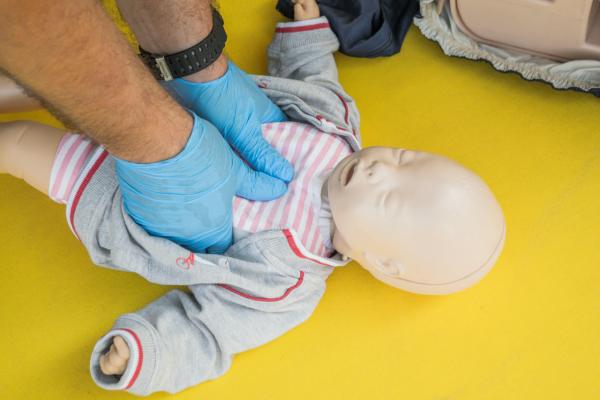
Infant and child CPR is the technical core of the certification. The course provides detailed instruction on compression depth, rate, and ratio for different age groups, and participants practise until the technique becomes familiar, because familiarity under pressure is what makes first aid useful. Airway management, recognition of absent or inadequate breathing, and the recovery position for children are all covered. AED use in paediatric scenarios is also included.
ii. Managing Childhood Emergencies
Beyond life support, participants develop their ability to assess a child's condition, identify the problem, prioritise the response, and communicate clearly with emergency services while continuing to provide first aid. The range of emergencies covered, choking, anaphylaxis, head injuries, burns, fractures, shock, loss of consciousness, reflects the full range of situations that can arise in a childcare setting during a normal working day.
iii. Illness and Injury Management
Illness recognition is where paediatric first aid most clearly differs from general first aid training. Meningitis, asthma, epilepsy, febrile convulsions, and diabetic emergencies look different in a child than they do in an adult. The early signs can be easy to miss in a busy crèche or nursery. The course trains participants to notice when a child's condition is changing, to know when something warrants an immediate call to emergency services rather than a wait-and-see approach, and to manage the situation appropriately while help is on the way.
4. Professional Benefits
A current paediatric first aid certificate matters when you're applying for jobs, when inspectors visit, and when parents are deciding where to bring their children. It's a credential with real, practical weight.
i. Employment Requirements
Paediatric first aid certification is increasingly listed as a requirement rather than a preference in childcare job advertisements across Ireland. Settings that advertise for room leaders, keyworkers, and childcare assistants routinely specify that a current paediatric first aid certificate is expected. Holding a valid certificate makes a candidate more employable and a current employee more valuable to their setting.
ii. Career Development
For anyone building a career in early years education or childcare, paediatric first aid certification is a credible continuing professional development credential. It demonstrates a genuine commitment to child safety and professional standards. For those moving into senior or supervisory roles, it is often a baseline expectation that comes well before other qualifications.
iii. Insurance Compliance
Many childcare settings' insurance requirements specify minimum first aid qualifications for staff. Ensuring that the relevant staff hold current, valid paediatric first aid certificates is part of meeting those requirements and keeping the setting's insurance position sound. A lapsed certificate could create an unintended gap in coverage that is only discovered at the wrong moment.
5. Maintaining Certification
Two years go quickly in a busy setting. Keeping track of expiry dates and renewing before a lapse creates a compliance gap, which is part of running a well-organised, inspection-ready facility.
i. Certificate Validity
The SafeHands Paediatric First Aid certificate is valid for two years from the date of issue. Employers and childcare professionals are responsible for monitoring expiry dates and arranging refresher training in good time. SafeHands offers refresher training and can work with settings to plan renewal schedules that ensure uninterrupted certification coverage.
ii. Continuing Professional Development
Refresher training before the current certificate lapses is recommended both to maintain uninterrupted certification and to ensure that techniques remain current. First aid guidance evolves over time, and skills that are not practised regularly tend to deteriorate. Keeping certification active is part of keeping the competence it represents genuinely reliable.
6. Quality Assurance
The SafeHands Paediatric First Aid qualification is appropriate for use in crèches, nurseries, schools, and other regulated childcare settings across Ireland. All training is delivered on-site at the client's setting by experienced instructors whose credentials are available on request. Sessions accommodate a maximum of 12 participants, ensuring that each participant receives adequate individual attention and hands-on practice time throughout the day.
Get your childcare team certified in Ireland. SafeHands delivers on-site paediatric first aid certification at childcare settings across Ireland. Call 01 7979836 or 087 3823223, email info@safehands.ie, or use the enquiry form at safehands.ie. Payment via Stripe, bank transfer, or phone, full upfront payment required.
7. Frequently Asked Questions
What is childcare first aid certification in Ireland?
A two-year qualification covering emergency response specifically for infants and children, CPR, choking, illness recognition, and management of paediatric emergencies.
Is it different from standard first aid?
Yes. Techniques differ significantly and the illness recognition component covers childhood conditions not addressed in standard courses.
How do I arrange training?
Contact SafeHands at 01 7979836, 087 3823223, info@safehands.ie, or via the enquiry form at safehands.ie.
What are the payment options?
Stripe, bank transfer (invoice emailed), or phone. Full upfront payment, no staged payments or payment plans.
Is training at our childcare facility?
Yes. All training is delivered on-site at your setting. SafeHands does not have its own training facilities.